Charles-Arthur Gonse
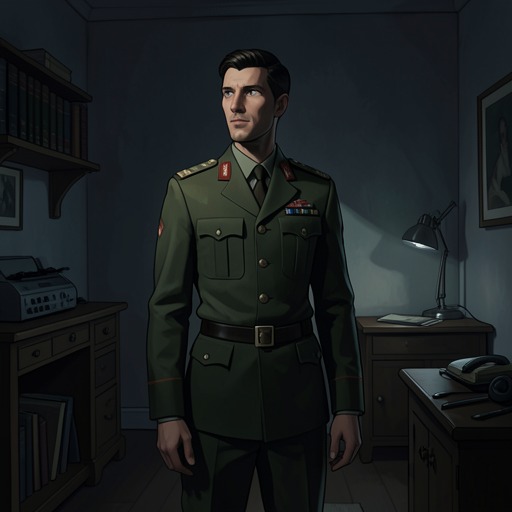
An Officer and a SpyCharles-Arthur Gonse, Chief of the Second Department and head of military intelligence, stands at the point where the Dreyfus investigation becomes a conflict over who is permitted to pursue the truth. Through his dealings with Georges Picquart, he moves from sponsor of Picquart’s advancement to an enforcer of the General Staff’s position: when evidence points toward Esterhazy, Gonse maintains the case against Alfred Dreyfus and invokes the chain of command to shut the inquiry down.
Identity and Position
Gonse is identified as Chief of the Second Department, the intelligence branch of the French War Ministry. That office places him above Picquart in the military intelligence hierarchy and gives him direct authority over Picquart’s work. The narrative introduces him not simply as a name among senior officers but as the person who can translate institutional policy into orders addressed to the investigator who has uncovered a competing explanation of the evidence.
His working habits reinforce the weight of that position. Gonse is known for fourteen-hour days, and even his enemies concede that this is how he keeps on top of his job. When Picquart unexpectedly encounters him in the War Ministry on a Saturday, Gonse has been walking the deserted corridor; the two men are both flustered when Picquart opens his office door and finds the intelligence chief facing him. The brief encounter makes Gonse’s presence feel less like ceremonial supervision than a persistent, personal command of the department’s business.
Sponsor of Picquart’s Advancement
Gonse is initially an advocate of Picquart’s advancement. He tells Picquart that the Minister of War and the Chief of the General Staff have been impressed by his conduct in the Dreyfus affair and by the experience he has gained in secret intelligence. The proposed reward is command of the Statistical Section. Gonse also explains that Jean Sandherr, its able current commander, is seriously ill and has held the post for ten years; he needs a rest, and Gonse does not expect him to recover.
The offer brings Picquart into closer proximity to intelligence work he regards as grubby and unlike the service he joined the army to perform. Gonse’s recommendation therefore has a double edge: it recognizes Picquart’s ability while directing him toward a role within the machinery that handles secrets. Before discussing sensitive information, Gonse asks whether anything in Picquart’s past or private life could make him vulnerable to blackmail. The question frames the appointment in practical terms: the office requires not only competence but protection against exposure.
The Dispute over the Bordereau
The relationship changes as Picquart brings Gonse evidence that undermines the original account of the bordereau. At a meeting at the Gonse family house in Cormeilles-en-Parisis, Picquart has come to brief the general on an urgent matter after Raoul le Mouton de Boisdeffre asks him to do so. Gonse receives him at his country home, where he has been working in the garden in shirtsleeves and a battered straw hat. The informal setting does not soften the dispute that follows.
As he considers Picquart’s case, Gonse flicks a match between his fingers and snaps it. He returns to the premise that the bordereau must have been written by an artillery officer with experience of all four departments of the General Staff. On that reasoning, he concludes that it could not have been Esterhazy and must have been Dreyfus. Picquart answers that the documents described in the bordereau were notes being handed over, not necessarily secrets obtained through a General Staff post. The one item actually handed over, the firing manual, could have been acquired by Esterhazy on a gunnery course. Picquart’s reading turns the supposed proof of privileged access into evidence for the opposite possibility: the traitor may have been an outsider gathering information and trying to sell it.
Gonse’s importance lies in his refusal to let that reversal displace the original hypothesis. The disagreement is not merely about how to interpret a list of military material. It exposes a widening divide between Picquart’s examination of the evidence and the senior intelligence officer’s insistence that the accusation against Dreyfus still holds. The man who had recommended Picquart for command now confronts him as a subordinate whose investigation threatens an established institutional conclusion.
Orders, Authority, and the Secret File
Gonse makes that division explicit when he formally orders Picquart, for the final time, not to investigate anything connected with the Dreyfus case and not to disclose information to anyone unauthorized to receive it. He lays out the hierarchy as a chain: the Minister of War gives orders to the Chief of the General Staff, the Chief gives orders to Gonse, and Gonse gives orders to Picquart. He presents obedience as the governing requirement of the army, warns Picquart of the consequences of disobedience, and receives no reply. Picquart salutes and leaves.
This order recasts secrecy from a practical safeguard into a means of controlling the investigation. Gonse does not only forbid further inquiry; he also restricts who may hear what Picquart knows. The order binds the investigator at precisely the point where the evidence calls for wider scrutiny, making the conflict between military obedience and independent examination concrete in a single encounter.
In a later visit, Gonse appears without the usual appointment and remarks on Picquart’s separate operation before asking to take the secret file on Dreyfus. He gives no explanation when Picquart asks why. The request returns the character to the central object of the affair: a dossier whose contents and circulation determine what can be known, by whom, and under whose authority. Across these scenes, Gonse is neither merely an administrator nor simply a personal antagonist. He is the senior officer through whom the institution’s command over intelligence becomes visible—and through whom the investigation’s pursuit of evidence meets the command to stop.